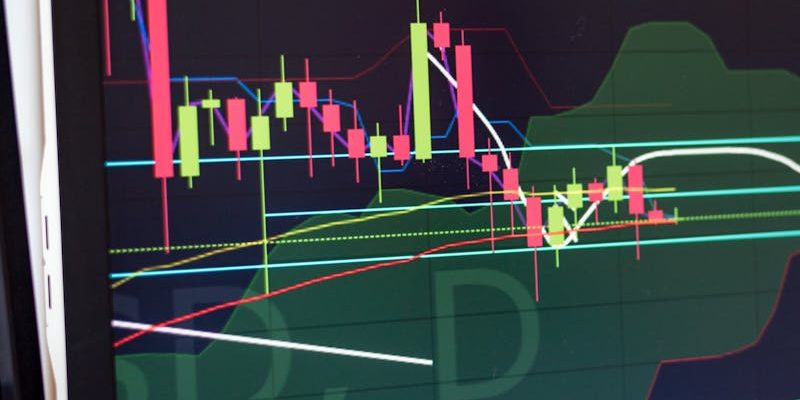
How to Identify an Engulfing Pattern
• Two-candle pattern: The Engulfing pattern consists of exactly two candles. The first candle is relatively small-bodied, and the second candle has a much larger body that completely covers the first candle's body from open to close.
• Second candle's body completely engulfs the first: The second candle must open beyond one end of the first candle's body and close beyond the other end. For a Bullish Engulfing, the green candle opens below the red candle's close and closes above the red candle's open. For a Bearish Engulfing, the reverse applies.
• Opposite colors: The two candles must be different colors. The first candle matches the prevailing trend (red in a downtrend, green in an uptrend), while the second candle is the opposite color, representing the new emerging force.
• Appears at trend extremes: A Bullish Engulfing is valid only after a downtrend. A Bearish Engulfing is valid only after an uptrend. Engulfing patterns in the middle of sideways consolidation have far less predictive power.
How to Trade the Engulfing Pattern
Entry
Enter on the close of the engulfing candle or at the open of the next candle. For a Bullish Engulfing, go long. For a Bearish Engulfing, go short. The next candle's direction provides additional confirmation.
Stop-Loss
For a Bullish Engulfing, place the stop below the engulfing candle's low. For a Bearish Engulfing, place the stop above the engulfing candle's high. This captures the full rejection range.
Target
Use a minimum 1:2 risk-to-reward ratio or target the next significant support/resistance level. The size of the engulfing candle often predicts the magnitude of the follow-through move.
Success Rate
The Bearish Engulfing is notably more reliable than its bullish counterpart, likely because panic selling tends to be more decisive than buying. Both patterns perform best on daily charts, at key support or resistance zones, and when the engulfing candle is accompanied by above-average volume. The larger the engulfing candle relative to the first candle, the more powerful the signal. Patterns where the engulfing candle also covers the first candle's shadows (not just the body) are the strongest form of this pattern.
Frequently Asked Questions
Related Patterns
Related Tools & Guides
Part of our Technical Analysis Guide